As we talked about in class and as is described on the websites of both games, The Oregon Trail and When Rivers Were Trails were made by different people for different purposes. Both games are intended to be educational—at least the original concept for The Oregon Trail, anyway—but have different areas of focus. The Oregon Trail is about settlers, and When Rivers Were Trails is about the Indigenous people being displaced by settlement. The gameplay is different in both, with The Oregon Trail originating as a text-based game and When Rivers Were Trails being a point-and-click game, but there are some similarities that I think mostly come from When Rivers Were Trails being a sort of response to The Oregon Trail. Both games have hunting mechanics, talking and trading with other people, a minigame where the player must travel by water and avoid obstacles, and maps—although I think it’s worth mentioning that the map in The Oregon Trail depicts the entire journey, while the map in When Rivers Were Trails only shows pieces of the journey at a time, perhaps to show that it wasn’t a journey with a clear ending point.
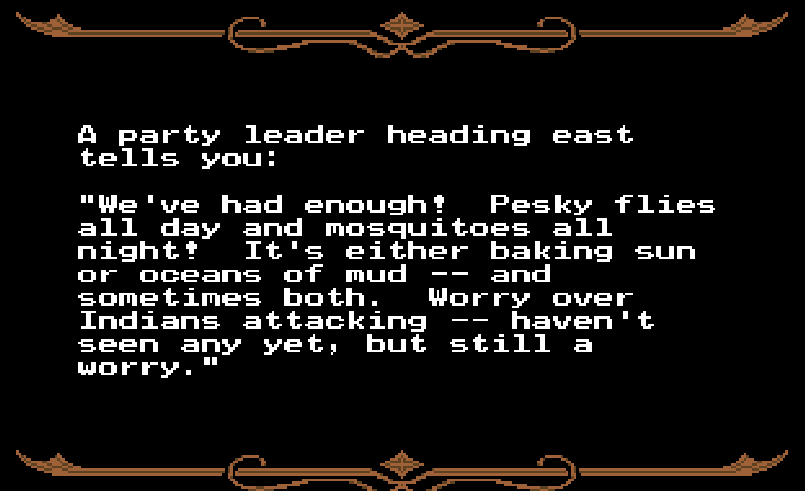
There are Native people in both games, but they are definitely treated differently. The Native people in The Oregon Trail are not really “characters” and instead exist to further the goals of the player character—the leader of a wagon heading to Oregon. It’s worth being said that no character in The Oregon Trail is fleshed out in any way, and most exist inconsequentially to be a part of the player character’s journey, but I did notice that none of the Native characters I met while playing The Oregon Trail were given names, instead referred to with titles like “a Sioux hunter” or “an Arapaho Indian,” while some of the white people the player interacts with are given names. The Native characters were also described differently by white characters, some of whom talked about the trading preferences of Native people and some of whom talked about fearing an attack by Native people—there seems to be no opinion given by the game to which description is “right.”
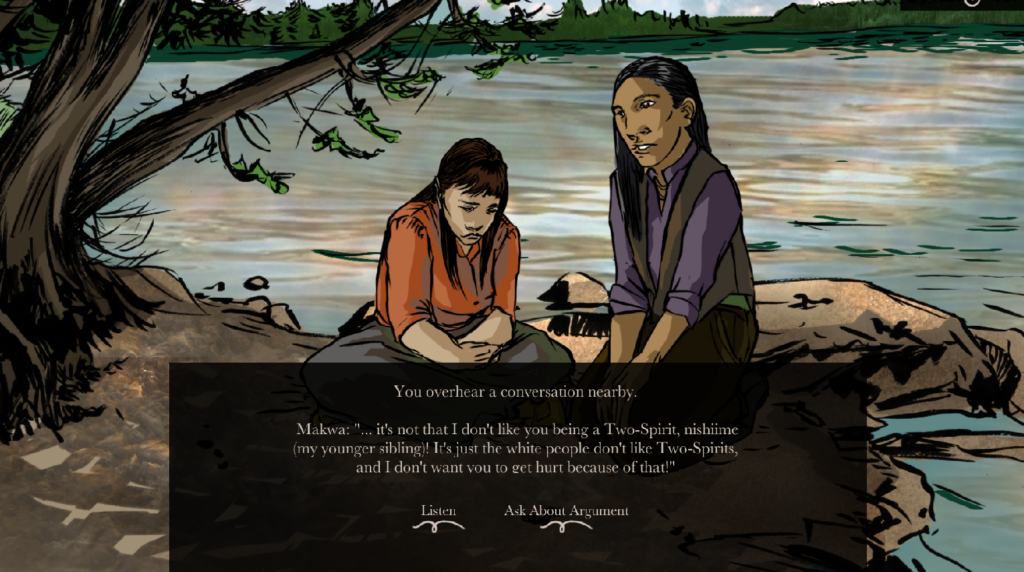
In When Rivers Were Trails, not only are many of the Native characters you interact with named and given stories and personalities, but the player often is given both the choice to “Talk” to the character, or to “Listen.” There are also moments when the player can help in a situation, offer advice, trade, or give gifts. Overall, it’s a much more human-focused game, and gives character to everyone—from the Native people the player interacts with to the Indian agents to the player themself. Another thing I noticed is that, in The Oregon Trail, the player manages an entire family, while in When Rivers Were Trails, the player character travels alone (but not without help and sympathy from other Native people enduring similar situations). I think that’s significant.
Video games can tell us a lot about history and culture depending on the narrative direction taken. The Oregon Trail is a fun game, but I don’t think it depicts the complex history of the Oregon Trail as well as it could. As I mentioned, When Rivers Were Trails is a much more in depth game in terms of character, and also is extremely informative about several aspects of Indigenous culture and historical events going on during the timeline of the game. I really enjoyed reading the information blurbs I could click on throughout the game, and was surprised and pleased by the discussion of Two-Spirit identities, as well as the different options the player can seek to keep the player character connected to their lifeways. It continuously tugged at my heartstrings, which I think was also because I am from Minnesota and I never knew about many of the things discussed in the game. I’m definitely going to keep playing it.
Tove, thank you so much for sharing these thoughts on the two games! I’m always fascinated by the backstory of The Oregon Trail as a game designed specifically for use in classrooms and then commercialized for home computers. I’m glad to hear that you had a much more engaging experience with When Rivers Were Trails, and I agree. There are clear differences in Indigenous representation, as well as how the two games grapple with colonialism as a theme. When Rivers Were Trails, as an Indigenous-developed game, is simply more immersive and more informed, and this makes for a far more educational experience. It is equally important to consider video/computer games as a mode for historical education. There are advantages as well as limitations, but undeniably, video games are a mode creating an interactive learning experience.