I would say that playing The Oregon Trail and When Rivers Were Trails is really a tale of two educational games. The Oregon Trail, originally created in 1971, was made to be an educational game. I would say, however, that the way I see it, I kind of interpret it as a game that educates on vibes alone. For example, in the starting screen, you can select the option to learn more about the trail. What pops up is, despite what I would expect from an education game (dates, reasons to travel the trail, major events, etc.), is just information on gameplay.
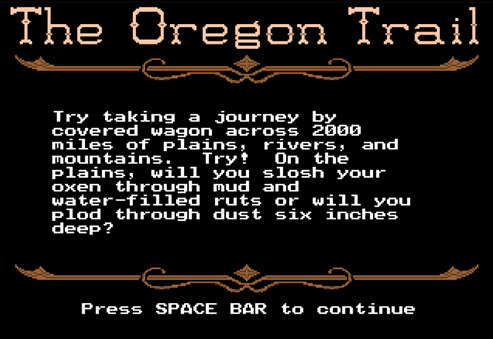
Throughout the game, you have the option to speak to people who drop little facts about the Oregon Trail (but it must be mentioned that you could play the entire game without talking to people, so…) but the facts are, again, just sort of vibe drops.
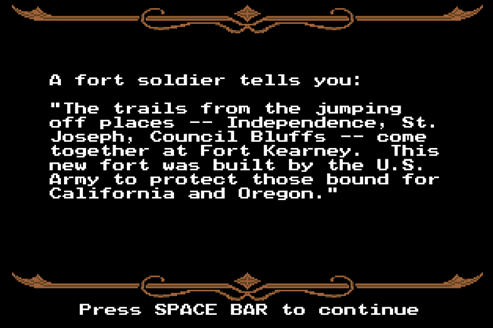
While this may be true, I fear it’s not the whole story. And again, there’s no real information here—I don’t think I’m getting educated at all! From the educational game!
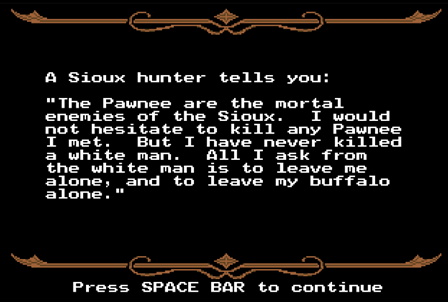
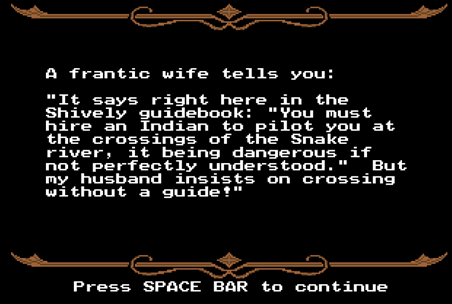
Onto the depiction of Native peoples—one thing is, obviously, the lack of naming actual tribes. Most references are vague allusions to Native people, and come up when you choose to talk to people—which, again, most children playing this game probably will not. Here’s one example:
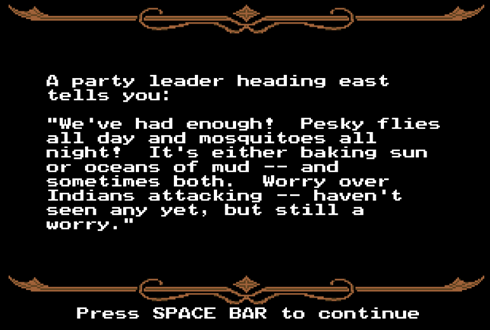
This was one of the first mentions of Indigenous people in the game, and it came almost halfway across the trail, around Fort Laramie. Certainly there are Indigenous people before that! There are two clear stereotypes of Native peoples in the game: the first, a dangerous warrior. The second, an environmentalist sage.
The visual depictions of Native people, which, again, only begin at Fort Laramie, are all the same, enforcing the idea that Indigenous peoples are a homogenous group of people, which is patently false.
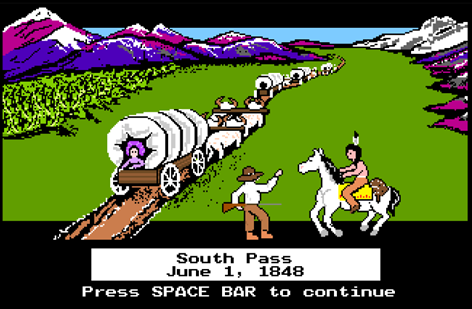
The questions this brings to my mind: why is the white man pointing a gun at the Indigenous person? Why is the Indigenous person not wearing a shirt? The Indigenous person has just one feather coming magically out of their head. Why?!
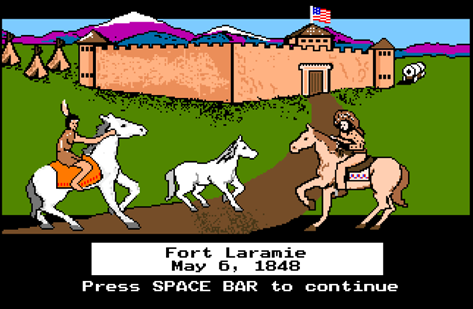
The questions this brings to my mind: are all Native people on white horses that are slightly rearing all the time? Is this a confrontation? Why is the Native person not wearing shoes? Do Indigenous people not have saddles?
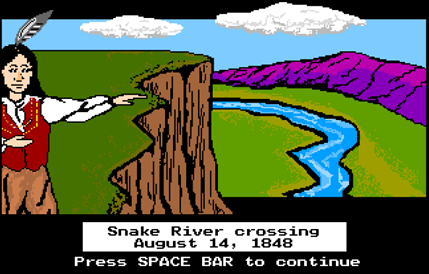
So Indigenous people aren’t always on horses. And they do wear clothes! But always vaguely buckskin colored blobs. And here comes the sage stereotype! At least what I know for certain is that all Indigenous people grow feathers out of their heads.
When Rivers Were Trails is a completely different experience. I do think these are for different age groups, but I also think that’s okay. I imagine that When Rivers Were Trails is partially aimed at the audiences who may have actually played The Oregon Trail when they were younger. When Rivers Were Trails is an actually educational game! You learn facts about specific Native tribes. The Indigenous people you speak to are specified by tribe (and they wear clothes!).
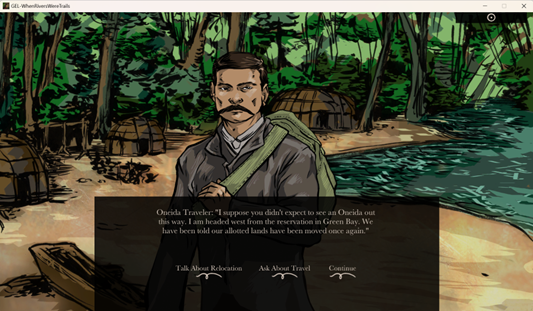
The Oregon Trail is wildly easy. Something that stood out to me was your ability to go hunting whenever. If you shoot over 100 pounds of game, you can’t bring it with you, but you can immediately go out and shoot more game, infinitely, without consequence. However, in When Rivers Were Trails, there are mentions of how the animals that Indigenous peoples traditionally hunted have been pushed to near extinction. You cannot hunt whenever you want, there are specified times, and you get one chance (and it’s NOT easy!). Alongside that, you unlock stories, which can be tidbits of information about Native peoples and their cultures or about relocation, which you can access from the main screen.
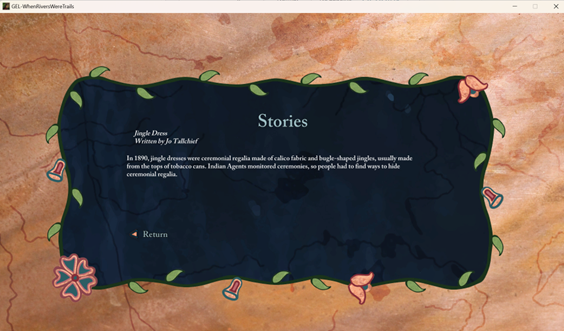
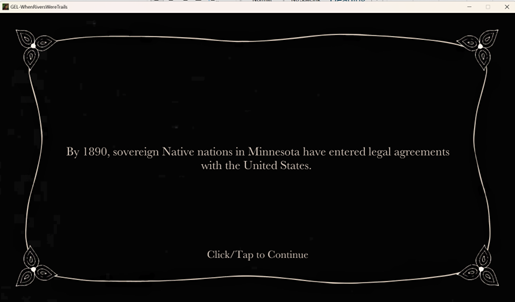
They have specific information—something that The Oregon Trail is severely lacking in—and they have sources! There are no specific dates in The Oregon Trail besides the date that you begin your journey—but I played twice and I couldn’t tell you what that date is. When Rivers Were Trails is interspersed with actual dates and events that were happening.
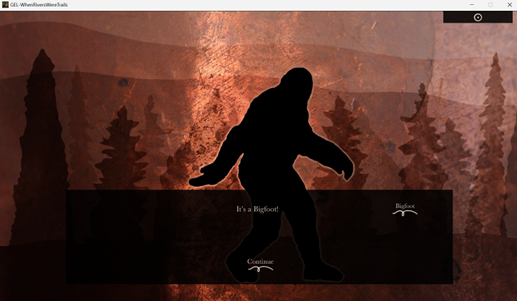
One thing that I found a little bizarre in a game that was otherwise seemingly very historically accurate was my encounter with Bigfoot. It felt out of place. But no matter!
It’s a little saddening to think that so many people probably learned about the Oregon Trail from that game when it has so little real, educational value. It serves to reinforce preconceptions about the Oregon Trail, reinforcing the folk tale version of the Oregon Trail that erases lots of what actually happened on the trail. I do feel the need to dedicate this blog post to Beth, my daughter who died on the Oregon Trail of measles, which she got twice, and also maybe Cholera and she maybe broke her arm twice. Sorry you died! You’ll get them next time.
Hi Daphne! Thank you for sharing these thoughts about the two games. It’s useful to compare them as “historical education” games, but also engage in the drastic differences in the representation of Indigenous peoples. The visuals included in this post truly walk through the narrative and highlight the progression of a very colonial narrative. There is usually very minimal depiction of Native Americans in The Oregon Trail, and when they do appear, it’s always to “serve” the settlers on the trail. I agree that it is also useful to approach When Rivers Were Trails as a “response” to The Oregon Trail– whether that was intended by the game’s designers or not. The reality is that The Oregon Trail has been such a staple in American pop culture, while at the same time reinforcing a certain depiction of an “American past.” WRWT offers a useful and educational critique, and I hope it is used in more history classrooms!
*Moment of silence for Beth* May her memory carry on.