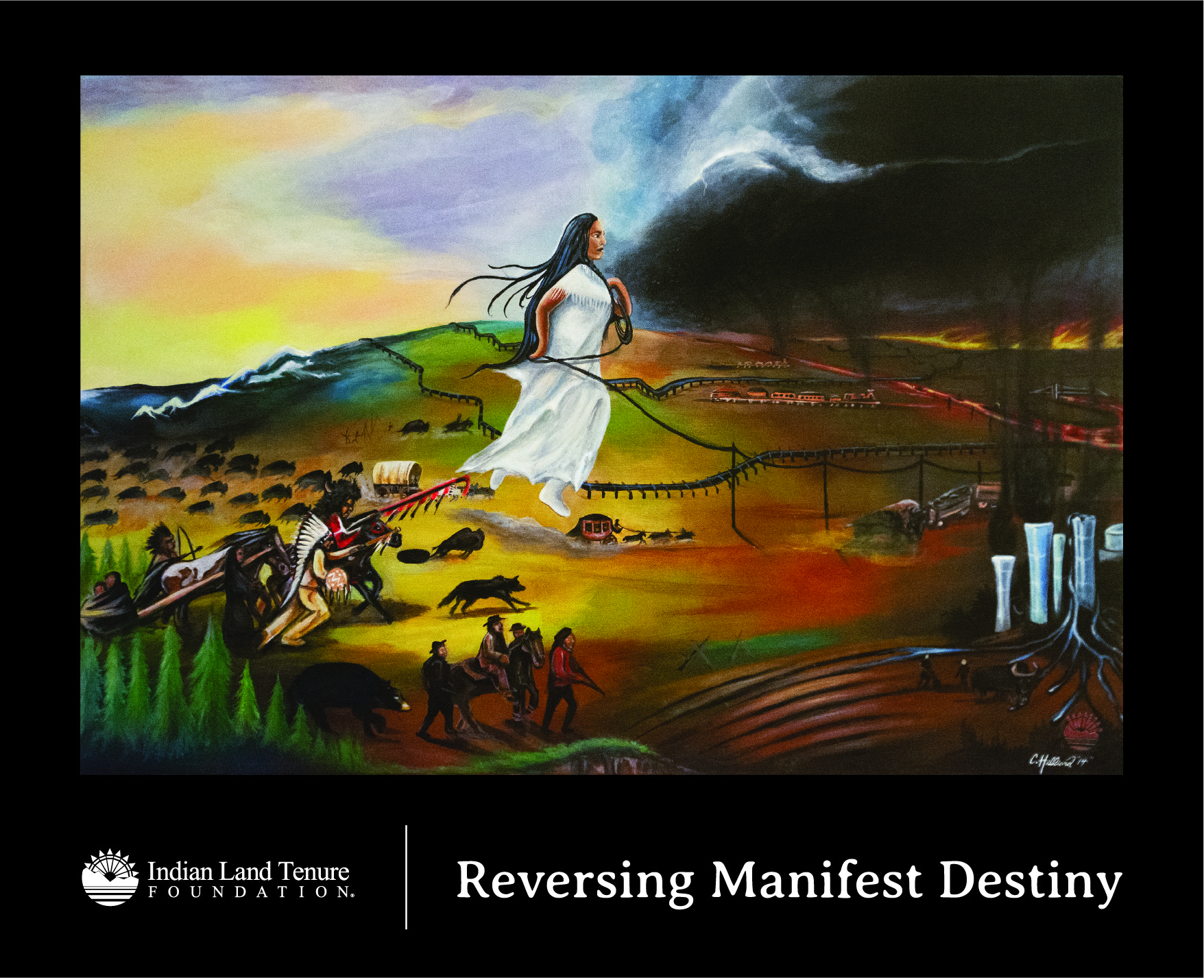
There was a belief that the U.S. westward expansion was both destined and justified. However, I believe that the manifest destiny was structured rather than destined. There are many ideas about manifest destiny, and one is that they felt as though there was a need to improve the land because its natural state was not good enough. The manifest destiny painting that we analyzed in class has many elements. It portrays hardworking settlers, homesteads, trains, and towns. Meanwhile, the representation of Native Americans is that they are at odds with the “progress” of settlement. I was astonished when I saw Reversing Manifest Destiny (2021), commissioned by the Indian Land Tenure Foundation. It’s a beautiful work of art that accurately highlights Native American history. I have only ever seen American Progress in history textbooks, and I remember questioning myself in 7th grade why Native Americans are portrayed negatively. I strongly believe that reversing manifest destiny should also be in textbooks.
In 1830, the Indian Removal Act was established; this treaty was the main mechanism for disposing of Indigenous lands. Native communities were trying to defend their homeland, but because of the settler’s persistence, they had to slowly rebuild their cultures after removal.
Learning about the history of California and the California Gold Rush was really interesting because I didn’t know that California was an incredibly diverse region of Native communities. In middle school, learning about the Gold Rush was more about finding gold than the violence and genocide that occurred to the Native Americans. The discovery of gold in the Sierra Nevada at John Sutter’s mill marked the beginning of one of California’s deadliest periods of Native American dispossession, brutality, and systematic death. The Gold Rush was not at all as peaceful as middle school made it out to be; in fact, it was extremely chaotic and disorderly. The Native peoples actively opposed it, but their efforts were in vain.
The American invasion of California is devastating because, on behalf of the US government, “military governors” were sent into California to oversee “Indian affairs” in the area. The expansion of ranching throughout California also relied on exploiting Native labor. On behalf of the US government, “military governors” were sent into California to oversee “Indian affairs” in the area. The exploitation of Native labor was necessary for ranching to spread throughout California. Military rulers who sided with the settlers imposed severe limitations on Native Americans’ freedom of movement and had them carry employment certificates on their journeys. This removed the free mobility of Native Americans.
Citation: https://iltf.org/wp-content/uploads/2020/03/RMD_Website_Image2.jpg