After playing the Oregon Trail game in class and the When Rivers Were Trails game at home, I learned a lot about the two. These two games were made by different people and to convey different perspectives. Both games are educational, showing a slightly realistic virtual reality of what happened in the past. The Oregon Trail game focused on how Settlers got to the western side of America, and the When Rivers Were Trails game focused on indigenous people being displaced and trying to rebel against them. The games have some of the same major mechanics as hunting, talking, trading, buying, and both deciding on how to deal with obstacles in the way like rivers.
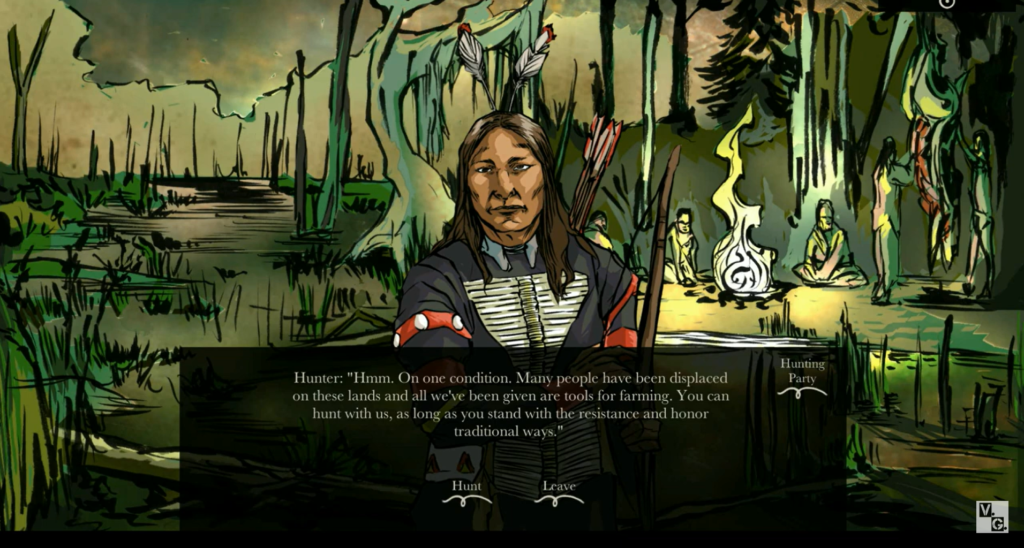
In both games Native Americans are both represented differently. The Native Americans in the Oregon Trail are not directly given names and they are more like NPS’c (non-playable characters). They have simple names or ID tags like Sioux Hunter or Arapaho Indian. Also, the NPS’s in the game also have different views on Native Americans. Some have the perspective of interacting with them for trade, whereas some fear them and are always scared because they think they are going to be attacked. In the When Rivers Were Trails game the Native Americans are given names, and it is clear that they are all different. In this game I had the option to talk, listen, offer advice, trade, or even give a gift. Also, in this game you are by yourself and in the Oregon Trail one you travel with your family. The Oregon Trail game tended to be more of a text-based game where x led to y. Compared to When Rivers Were Trails it was a look around and click the text bubble and see what they have to say.
I believe that video games can tell us a lot about historical and cultural narratives. Both of the games that I have played represent very great historical and cultural narratives. In the Oregon Trail game, I think that it is a great historical narrative. It does its job of giving the situation with all the possible outcomes that could have very well happened back then in the past. It’s like you’re the settler and you and your family are going on a long journey, and you have to prepare, think, and decide on actions that happen to you in the game. In the Where Rivers Were Trails game, it gave a great cultural narrative where it got you involved with more people, and you could read what each individual said. It took you into the game and made you feel like you were actually interacting with an indigenous tribe member back in the past.

Hey Lucas, I really enjoyed reading your analysis of both games! I only played the Oregon Trail game in class, but now that I know more about the When Rivers Were Trails game, I’m definitely going to check it out. It’s interesting how both games have different views on Native Americans. You make a valid point about how both games were made by different people; therefore, they are going to highlight the different perspectives. While playing the Oregon Trail, I got the feeling that I wasn’t going to interact with Indigenous people since it was focused on settlers getting to the west. I’m glad that the When Rivers Were Trails game highlights Native Americans and makes them an essential part of the game. On the Oregon Trail, it was more about me worrying whether my family was going to drown or break a leg, and I wanted to know more about how indigenous people were displaced and how they rebelled.
Hi Lucas, thank you for sharing these thoughts on the two games! I’m always fascinated by the backstory of The Oregon Trail as a game designed specifically for use in classrooms. It also involves far more math than history, in my opinion! I’m glad to hear that you had a much more engaging experience with When Rivers Were Trails, and I agree. It is simply more immersive and more informed, and this makes for a more educational experience. It is equally important to consider video/computer games as a mode for historical education. There are advantages as well as limitations, but undeniably, video games are a mode creating an interactive learning experience.